
Chebureki look like a half-moon pastry. They taste like the best thing you’ve eaten at a street market. And their history crosses more borders than most people expect.
What is chebureki
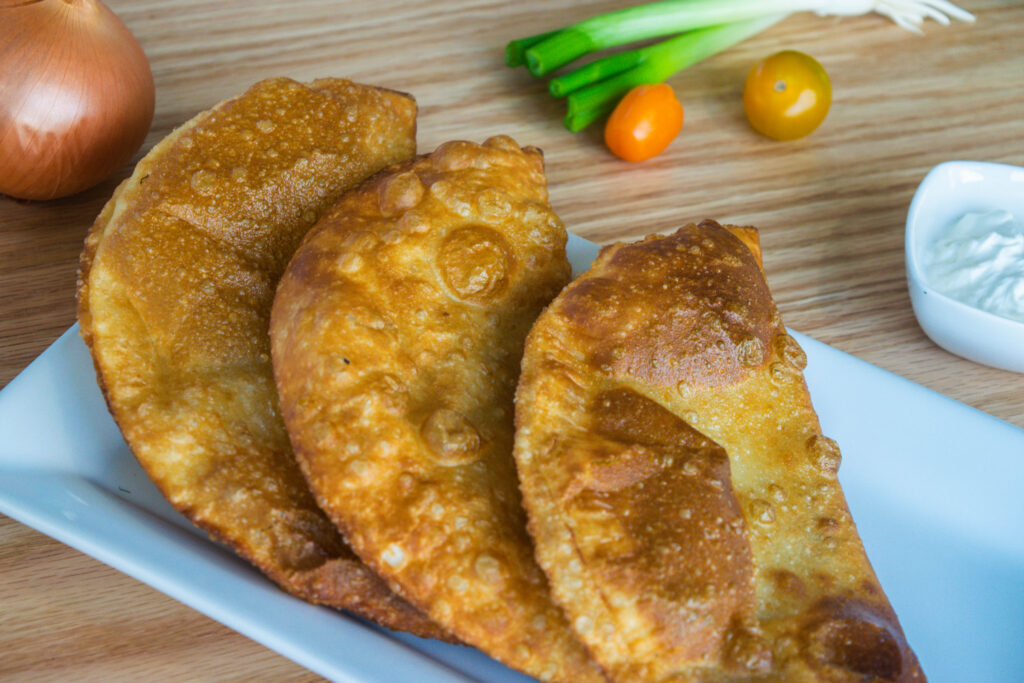
Chebureki is a large, deep-fried, half-moon-shaped pastry filled with seasoned ground meat and onion. The dough is thin, the edges are crimped shut by hand, and the whole thing gets fried until the outside is crisp and blistered while the inside stays juicy.
It’s meant to be eaten hot, ideally within a few minutes of coming out of the oil, while the crust is still crackling.
Origins in Crimean Tatar cuisine
Chebureki started as a dish of the Crimean Tatars, the Turkic people native to the Crimean Peninsula. The name itself comes from Crimean Tatar roots and translates roughly to raw pie, a reference to the fact that the meat filling goes in uncooked and sealed, only becoming fully cooked once the whole pastry hits the hot oil.
It’s a detail that tells you something about the technique. The filling has to cook through entirely during frying, which is part of why chebureki are fried in generous oil rather than baked or pan-fried.
How chebureki spread across the Soviet Union
Chebureki didn’t stay in Crimea. During the Soviet era, Crimean Tatars were forcibly deported from their homeland to Central Asia, carrying their food traditions with them into places like Uzbekistan and Kazakhstan.
From there, chebureki spread further still, reaching Moscow and other major Soviet cities by the 1950s. Dedicated cheburechnaya cafes opened across the Soviet Union, serving them fresh and cheap to anyone walking by. For a generation of Soviet citizens, chebureki wasn’t a specialty dish. It was a quick, familiar bite grabbed on the way somewhere else.
The multicultural thread
Chebureki’s path, from Crimea through the Caucasus and Central Asia and into Russia, is exactly the kind of dish Elena grew up eating in multicultural Almaty.
Almaty sat at a crossroads of exactly these communities, where food that started somewhere specific became something everyone shared. It’s the same pattern behind a lot of what Alyonka serves, dishes that moved through multiple cultures before landing on a plate here in Boise.
How Alyonka makes them
At Alyonka, chebureki are made the way they’re supposed to be: dough rolled thin, filled generously with seasoned meat, sealed by hand, and fried to order.
Nothing about it is rushed, and nothing is made ahead of time to sit and wait. That’s part of why they disappear fast once they hit the table.
Order chebureki as a starter. They go fast.