
Soviet food has a reputation problem. Ask most people what comes to mind and you’ll hear grey cafeterias, bread lines, and food that existed to fill you up rather than satisfy you.
That reputation isn’t entirely wrong, but it’s incomplete. Behind the shortages was a food culture shaped by real ingenuity, and some of the dishes that came out of that era are still on tables everywhere today, including at Alyonka.
The Soviet food paradox
The USSR had real food shortages, especially in the decades after the revolution and again during and after World War II. Bread lines, rationing, and empty store shelves were part of daily life for generations of Soviet citizens.
At the same time, that same era produced some of the most beloved dishes in Eastern European cuisine. Scarcity didn’t stop good cooking. In a lot of ways, it shaped it.
How Soviet policy spread regional dishes everywhere
Before the Soviet Union, food in the region was regional in the truest sense. What you ate depended heavily on where you lived, since Uzbek cooking, Caucasus cooking, and Siberian cooking had little reason to overlap.
Soviet policy changed that. As part of a broader push toward what the state called “friendship of peoples,” regional dishes were folded into one shared Soviet cuisine. Uzbek plov, Caucasus shashlik, and Siberian pelmeni all stopped being regional specialties and became dishes any Soviet citizen might eat, regardless of where they were born.
That’s a big part of why these dishes are so widespread today. They didn’t stay local. Soviet-era policy spread them across an entire union, and they outlasted the country that spread them.
The Book of Tasty and Healthy Food
In 1939, the Soviet government published The Book of Tasty and Healthy Food, a cookbook that quickly became something closer to a cultural bible than a kitchen reference.
It was overseen by Anastas Mikoyan, the Soviet minister in charge of the food industry, and packed with recipes, nutritional guidelines, and instructions on how a properly cultured Soviet citizen should eat. Millions of copies were printed over the following decades, and it stayed in circulation for most of the Soviet period.
The gap between the book’s glossy, abundant table settings and what was actually available in Soviet stores was often wide. Even so, it shaped how generations of families cooked and what a normal meal was supposed to look like.
How scarcity shaped creativity
When ingredients are limited, cooks get resourceful. Soviet-era cooking leaned hard on what was reliably available: beets, cabbage, potatoes, and whatever could be fermented or pickled to last through the winter.
That constraint produced real technique. Fermentation and pickling weren’t just about preservation, they became a way to build flavor out of a short list of ingredients. A lot of the dishes people now think of as classic Eastern European cooking exist because someone had to make three vegetables interesting for six months straight.
Where this connects to Elena
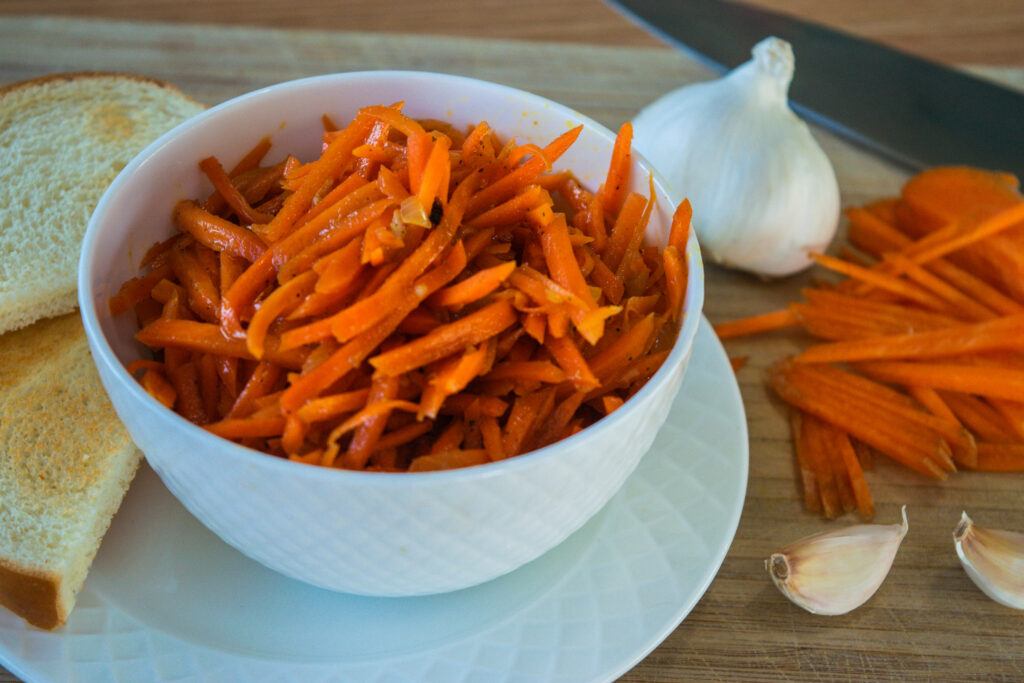
Alyonka’s food is shaped directly by this era, not as history read about after the fact, but as something Elena actually grew up inside of.
She was raised in Soviet-era Kazakhstan, in a neighborhood in Almaty where Korean, Armenian, Kazakh, and Russian families lived side by side. Soviet policy had moved all of these communities into overlapping spaces, and over generations, their food traditions merged.
That’s where a lot of what makes Alyonka’s menu distinct actually comes from. The koreiskaya morkovka, a Korean-style spiced carrot salad, traces back to the Korean communities of Soviet-era Kazakhstan. The shashlik marinade comes from an Armenian neighbor’s family recipe. The pelmeni are Russian to their core. None of it would exist in the same form without the multicultural Soviet world Elena grew up in.
Come taste a menu shaped by that history.