
Koreiskaya morkovka is one of those dishes that raises a question the moment you hear the name.
“Koreiskaya” means Korean in Russian. But if you’ve spent any time in Korea, you’ve probably never encountered this salad there. It doesn’t appear on Korean menus. It isn’t part of Korean culinary tradition in any recognizable way.
So why is it called Korean?
The answer runs through one of the most overlooked chapters of Soviet history, a forced deportation across thousands of miles of steppe, and a neighbor’s kitchen in Almaty, Kazakhstan. It ends on Elena’s menu at Alyonka.
What Is Koreiskaya Morkovka?
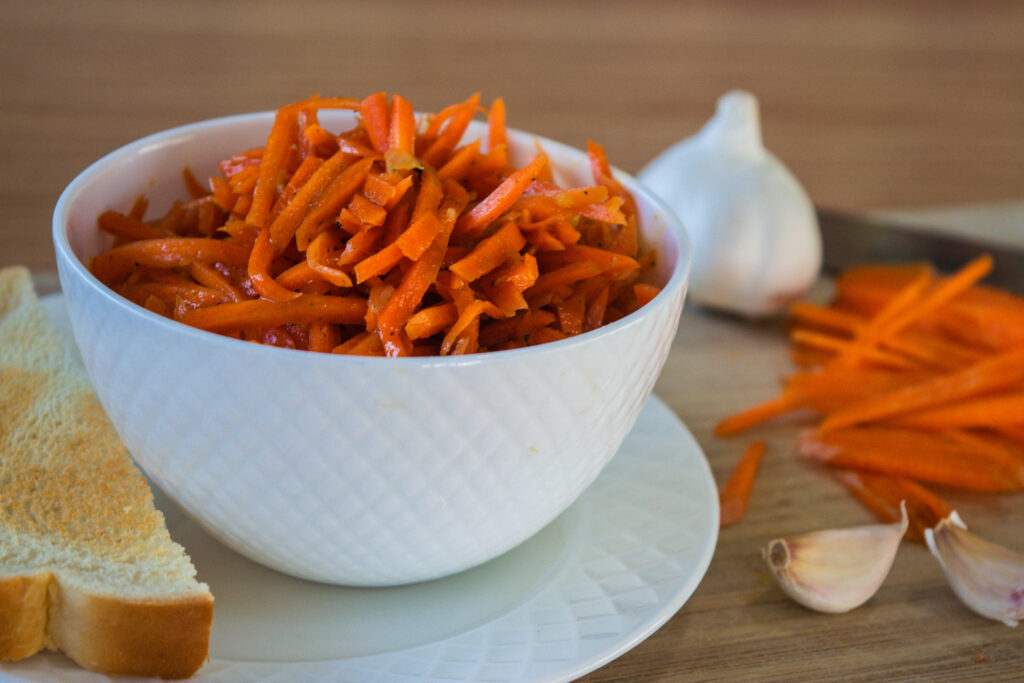
At its simplest, koreiskaya morkovka is a cold marinated carrot salad. Carrots are julienned into long thin strips, then dressed with vinegar, garlic, coriander, and hot oil poured directly over the top so the spices bloom on contact. The result is tangy, garlicky, lightly spiced, and deeply savory.
It’s served cold, which makes it a natural fit for a spread of appetizers. It holds well, travels well, and gets better as it sits and the flavors develop.
The texture is firm but yielding. The flavor is nothing like what most people expect from a carrot. It’s the kind of dish that turns carrot skeptics into people who ask for seconds.
Where It Actually Comes From
To understand koreiskaya morkovka, you have to go back to 1937.
Stalin, in the grip of wartime paranoia, ordered the forced deportation of the entire ethnic Korean population living in the Soviet Far East. Around 170,000 people, known as the Koryo-saram, were loaded onto cattle cars and transported thousands of miles to Kazakhstan and Uzbekistan. The official justification was fear of Japanese espionage. The real reason was ethnic suspicion dressed up as national security.
The Koryo-saram arrived in Central Asia with almost nothing. They were farmers who knew how to grow rice and napa cabbage. In Kazakhstan, napa cabbage wasn’t available. What was available were carrots, in abundance.
So they adapted. The fermented, spiced vegetable tradition they carried from Korea, the tradition that produced kimchi, got rebuilt around what was on hand. Carrots replaced cabbage. The flavors shifted to fit local spices. A new dish emerged from the wreckage of a deportation.
The salad spread from the Korean communities of Central Asia across the entire Soviet Union, eventually appearing on tables from Moscow to Minsk regardless of the ethnicity of the people eating it. It became a Soviet staple, beloved everywhere, its origins largely forgotten by the people who ate it most.
It is, as the history goes, virtually unknown in Korea itself. The dish belongs to the Koryo-saram, the Soviet Koreans who created it, and to the countries where they were forced to rebuild their lives.
How It Got to Alyonka
Elena DeYoung grew up in Almaty, Kazakhstan, in a neighborhood where Kazakhs, Russians, Koreans, Germans, and Armenians all lived side by side. Each community cooked its own food. Each community shared it.
The Korean families in her neighborhood made koreiskaya morkovka. Elena grew up eating it. It became part of the flavor memory she carried with her when she left Kazakhstan, moved through Brooklyn and Portland, and eventually settled in Boise.
When she opened Alyonka in 2019, koreiskaya morkovka went on the menu. Not because it fits neatly into a category called “Russian cuisine,” but because it was part of the reality of where Elena grew up. The menu at Alyonka has always reflected that reality: a Central Asian city in the late Soviet period, where food crossed cultural lines constantly because that’s what food does when people live close together.
The carrot salad on Elena’s menu is a direct line back to her neighbors in Almaty. It is, in its own way, one of the most specific and personal dishes she serves.
Why It Belongs on Your Table
Koreiskaya morkovka is excellent on its own. It’s also the kind of salad that makes everything around it better.
Order it as part of an appetizer spread alongside shuba, pelmeni, or pickled vegetables. The brightness and acid cut through the richness of the dumplings. The garlic and coriander add a layer of flavor that plays well with almost everything else on the menu.
It’s one of those dishes that people who grew up eating it recognize immediately and people who’ve never had it don’t quite have a reference point for, until the first bite.
You can explore more of the authentic Russian and Central Asian dishes on Alyonka’s menu.
Come Try It
Alyonka is at 2870 W State St in Boise. Call 208-344-8996 to make a reservation or ask about the menu.
Order the koreiskaya morkovka as part of your appetizer spread. It’s a dish with a story worth knowing, and a flavor worth coming back for.
The history is interesting. The salad is better.