
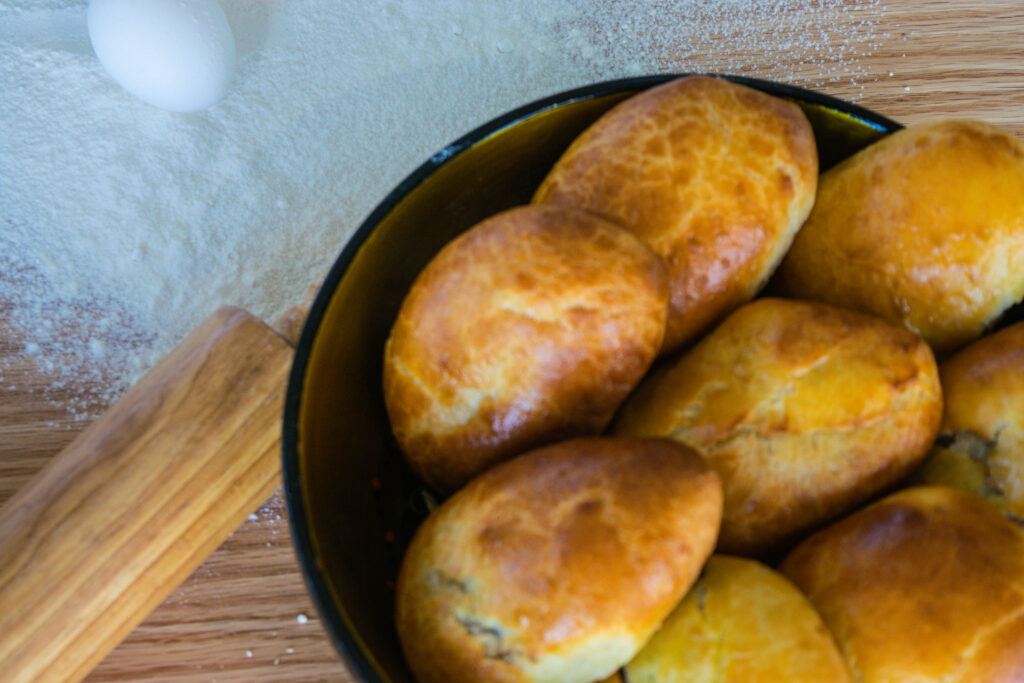
Pirozhki are small, hand-sized pastries filled with savory or sweet fillings, baked or fried until golden, and eaten without utensils, without a plate, and often without slowing down.
Think of them as Russia’s answer to the hand pie except they’ve been around since the 15th century, traveled from Siberian villages to street corners across the former Soviet Union, and somehow still taste exactly like something someone made for you at home.
They are one of the most practical and satisfying things in all of Russian cooking. And most people in Boise have never had one.
Where Pirozhki Come From
The word pirozhki is the diminutive of “pirog,” which simply means pie in Russian, little pies to be exact. That’s what they are, and what they’ve been since the 1400s.
Early pirozhki were baked in the large central masonry ovens that heated Russian homes through the winter. These ovens were the center of domestic life: they warmed the room, dried herbs, and did the cooking all at once. Bread went in first, then the larger dishes, and then, as the temperature dropped toward the end of the day, the smaller pastries. Pirozhki were a way to use what was on hand, wrap it in dough, and make it portable.
Pies and pastries have been a cornerstone of Russian food culture for centuries, appearing at celebrations, markets, and everyday meals across the country.
That portability is what made pirozhki spread.
The Street Food of the Soviet Era
By the Soviet period, pirozhki had moved from home kitchens to street corners. Vendors sold them from trays and carts outside train stations, markets, schools, and factory gates. They were the to-go meal of miners, students, soldiers, and anyone who needed something filling and fast.
A pirozhok (the singular form) cost next to nothing and kept you going for hours. The fillings varied by region, by season, and by whatever was available: ground beef with onion, braised cabbage, potato and mushroom, boiled egg and scallion, or sweet fruit fillings for a quick dessert.
The beauty of pirozhki is that the format is fixed and the filling is infinite. Every family had their version. Every city had its vendor. Every region had its preference.
As the Soviet Union spread across Central Asia, pirozhki went with it. In Kazakhstan, in Uzbekistan, in Georgia and Armenia and Ukraine, the little pastries became part of the local food landscape the same way they had in Russia: practical, filling, universally loved.
What Goes Inside
The most common savory fillings include:
Ground beef and onion. The classic. Seasoned simply, cooked down, and tucked inside a pillow of dough. The most recognizable version for most people.
Cabbage. Braised until soft and lightly sweetened by the heat. One of the oldest and most traditional fillings, and the one that surprises people most with how satisfying it is.
Potato and mushroom. Earthy, hearty, and completely meatless. A staple during lean times and religious fasting periods, and genuinely delicious in its own right.
Sweet fillings. Apple, cherry, or jam, for a version that sits comfortably between a pastry and a dessert.
The dough matters as much as the filling. A good pirozhki dough is soft and slightly enriched, with a light, fluffy interior and a golden exterior that holds everything together without being heavy or dense.
Elena’s Version at Alyonka
At Alyonka, the pirozhki are baked, not fried. The dough is soft and golden. The fillings are made from scratch the same way everything else at Alyonka is made: no shortcuts, no pre-made bases, no guessing about what’s inside.
For first-timers looking at the menu and unsure where to start, pirozhki are the right answer. The flavors are immediately familiar even if the name isn’t. Dough, a savory filling, warmth. There’s nothing to decode.
They also travel well, which is part of what made them popular for a thousand years and what makes them a good choice if you’re picking up food on the way to one of Boise’s parks.
Order them as a starter for the table, or take a few home. They reheat well, and they’re the kind of thing that disappears faster than you expected. Make a reservation or plan your visit at Alyonka. Alyonka is at 2870 W State St in Boise. Call 208-344-8996 to book your table or place a pickup order.