
What is buckwheat? Most Americans have a vague sense that it exists. Buckwheat pancakes, maybe. Something they’ve seen on a health food label.
In Russia, it’s been on the table at almost every meal for centuries. Breakfast porridge, a side dish with meat, a filling for pastries. It’s so embedded in Russian daily life that the Russian word for it, grechka, carries a kind of cultural weight that’s hard to translate. It’s not just a grain. It’s a staple.
If you’ve noticed it listed as a side option at Alyonka and wondered what you’d be getting, here’s everything worth knowing.
What Buckwheat Actually Is
Despite the name, buckwheat has nothing to do with wheat. It’s a pseudocereal, which means it’s used like a grain but doesn’t come from a grass. It’s actually more closely related to rhubarb and sorrel than to wheat or rice.
The seeds are small and triangular, with a distinctive shape that’s easy to recognize once you’ve seen it. When cooked, they turn tender and slightly chewy, with a flavor that’s earthy, nutty, and more complex than most grains. It’s a flavor that takes some people a moment to place and others immediately recognize as something they want more of.
Buckwheat is also naturally gluten-free, which matters for anyone navigating a wheat intolerance. The name is misleading. The grain is safe.
Where It Came From
Buckwheat originated in China and made its way westward through Mongolia, reaching Russia around the 14th century. The timing matters: buckwheat arrived in a country with cold winters, short growing seasons, and large stretches of poor, acidic soil that didn’t support more demanding crops.
Buckwheat grows in all of those conditions without complaint. It tolerates cold. It thrives in poor soil. It matures quickly. For a country that needed reliable food crops through difficult seasons, it was an ideal fit.
Buckwheat became one of the most important foods in Russian history, feeding peasants and soldiers and eventually becoming a staple of everyday cooking across the country. During times of shortage, it was often one of the few things available. During times of plenty, people ate it anyway because they’d grown up with it and it was genuinely good.
Necessity became tradition. Tradition became cuisine.
How Russians Eat It
Grechka shows up in Russian cooking in several forms.
As a breakfast porridge, cooked with water or milk and topped with butter, it’s the Russian equivalent of oatmeal: simple, warming, and eaten before the day begins.
As a side dish with meat, it’s where buckwheat really earns its reputation. The earthy, nutty flavor pairs naturally with rich, buttery sauces in a way that rice or egg noodles don’t quite replicate. The grain absorbs flavor without losing its own character, which makes it a better companion to a complex sauce than a more neutral starch.
As a stuffing for pastries and pirozhki, buckwheat adds texture and depth to a filling that might otherwise be flat.
In Soviet-era Russia, grechka became so culturally significant that shortages of it were treated as a national event. People stockpiled it. It was a marker of stability. When grechka was available, things were okay.
Why It Works So Well in Russian Cooking
The pairing of buckwheat with the cream and butter-forward sauces of Russian cuisine isn’t accidental. The earthiness of the grain cuts through the richness of a stroganoff sauce the way a more neutral starch wouldn’t. It adds a layer of flavor rather than just filling space on the plate.
It’s also nutritionally dense in a way that fits the logic of Russian winter cooking. More protein than rice or corn. High in fiber and antioxidants. The kind of food that sustains you rather than just filling you up temporarily.
Russian cooks didn’t think about it in those terms. They just knew it kept them going. The nutritional science caught up later.
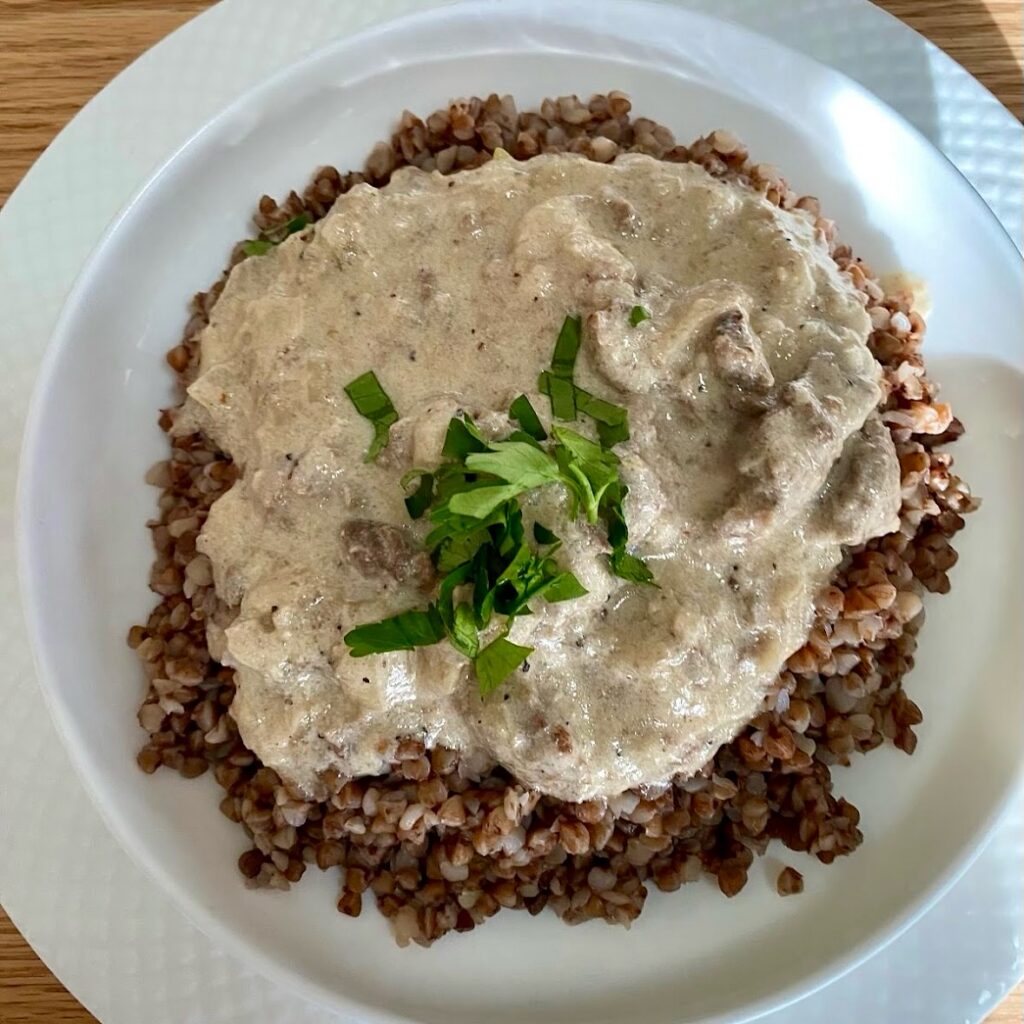
Buckwheat at Alyonka
At Alyonka, buckwheat is offered as a side option alongside the beef stroganoff, which is exactly the traditional Russian pairing. When Elena serves stroganoff over grechka, she’s serving it the way it was designed to be eaten, not with egg noodles as an adaptation for Western tastes, but with the grain that Russian cooks have been pairing it with for generations.
If you’ve been ordering the stroganoff with egg noodles, try it over buckwheat on your next visit. The difference is worth experiencing. The nutty, earthy grain absorbs the sour cream sauce in a way that changes the whole character of the dish.
Buckwheat is just one of the many flavors and ingredients that define Russian cuisine at Alyonka.
Try It on Your Next Visit
Alyonka is at 2870 W State Street in Boise. Call 208-344-8996 to make a reservation.
When you order the stroganoff, ask for it over buckwheat. It’s a small choice that makes a noticeable difference, and it’s the closest thing to eating the dish the way Elena grew up eating it.
Some things are traditional for a reason. Grechka is one of them.