
Before refrigerators, before canning, before grocery stores, Russians were making pickled vegetables.
Not because it was trendy. They pickled because winter was long, growing seasons were short, and fresh food simply wasn’t an option for most of the year. What started as a matter of survival became one of the defining traditions of Russian cooking. It’s still on the table today, including at Alyonka.
Winter made it necessary
Russia’s climate doesn’t leave much room for error. Across most of the country, the growing season lasts only a few months. Once the first frost hits, fresh produce disappears until spring.
That left families with a hard question every autumn: how do you make a summer’s harvest last through six or seven months of cold?
The answer was salt, brine, and time. Cucumbers, cabbage, tomatoes, beets, and mushrooms went into barrels, submerged in saltwater, and left to transform. It wasn’t a delicacy at first. It was how a household stayed fed until the ground thawed again.
A tradition older than the country itself
Pickling in Russia isn’t a modern habit. It’s an ancient one. Historical evidence points to Slavic peoples fermenting cabbage and brining cucumbers as far back as the twelfth century, long before Russia existed as a unified nation. Russia’s fermented food heritage stretches back further than most people realize.
By the twelfth through fourteenth centuries, the process had grown into something bigger than food storage. It became a communal ritual.
When a family started making sauerkraut for the winter, it was an occasion. Village girls would put on their nicer clothes and gather at the house to help chop cabbage, often singing together as they worked. In the evening, the young men of the village would show up with small gifts for the hostess and the group. A practical necessity had turned into one of the year’s social events, a reason for a community to come together before the cold set in.
What gets pickled, and why each one is different
Walk through a Russian pantry in autumn and you’d find more than cucumbers in brine. Cabbage, tomatoes, beets, and wild mushrooms each had their own approach, shaped by texture, size, and what the brine needed to draw out or protect.
Cabbage became sauerkraut, shredded fine and packed tight so its own liquid could rise and cover it. Cucumbers went in whole, layered with dill, garlic, and whatever aromatic leaves a family had on hand, oak, cherry, or currant, each one adding something different to the flavor and the crunch. Tomatoes were pickled firmer and less ripe, so they’d hold their shape through months in brine. Mushrooms, foraged from the forest in a short window each fall, took even more care, since getting the salt wrong could mean the difference between a pantry staple and a spoiled batch.
Every household had its own version, passed down and adjusted generation to generation. There was no single correct recipe. Only the one your family used.
Why Russian pickles taste different
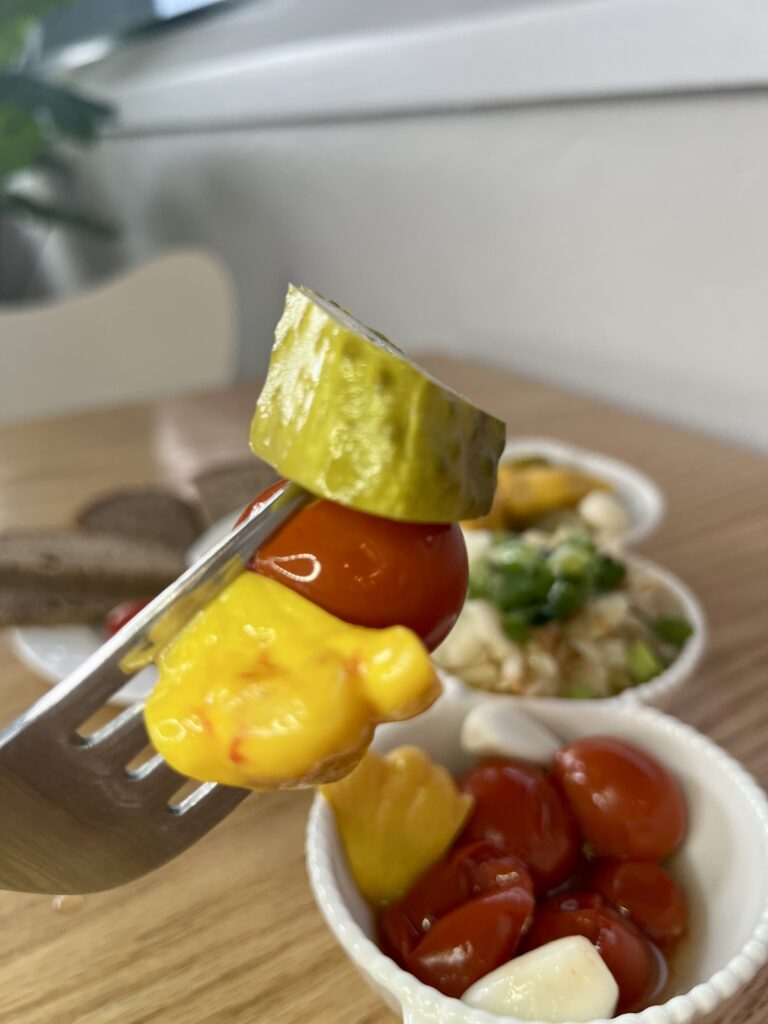
If you’ve had vinegar dill pickles off a grocery store shelf, that’s not quite what traditional Russian pickling is. The classic method skips vinegar entirely. Vegetables go into a saltwater brine and ferment naturally, a process called lacto-fermentation.
As the vegetables sit, naturally occurring bacteria convert their sugars into lactic acid. That’s what gives lacto-fermented vegetables their tangy, complex bite, a flavor vinegar can’t quite recreate on its own.
There’s a practical reason this mattered too. Fermented vegetables held onto their nutrients through the winter, at a time when fresh produce, and the vitamins that came with it, simply wasn’t available.
Where this connects to Elena
For generations of Russian families, this wasn’t something read about in a cookbook. It was something you did at the end of summer, when the harvest needed somewhere to go before it spoiled.
Elena grew up in that rhythm. She was born and raised in Almaty, Kazakhstan, in a neighborhood where German, Armenian, Korean, and Russian families lived side by side and traded recipes as often as they traded stories. Pickled vegetables were a staple of winter meals there, made the same way they’d been made for generations.
She never inherited written recipes from her grandmother. She remembered flavors. That’s still how she cooks today, and it’s why everything at Alyonka is made from scratch, no cans, no shortcuts. It’s also why fermentation shows up across so much of the menu, not just the pickled plate.
How it shows up at Alyonka
The pickled vegetable plate at Alyonka isn’t pulled from a jar. It’s made in-house, the same way it would have been made in a Russian kitchen generations ago. Real brine, real fermentation time, no vinegar standing in for the process.
It’s a small dish with a long history behind it, a direct line back to families who needed a way to survive the winter and turned it into something worth savoring.
If you’ve ordered it at Alyonka before, now you know what you were tasting. If you haven’t, this is a good week to order the pickled vegetable plate as a starter on your next visit.