
Most people have eaten beef stroganoff at some point. A school cafeteria, a church potluck, a box from the grocery store with a packet of seasoning inside.
Most people have not eaten real beef stroganoff.
The real version and the shortcut version share a name. That’s about where the similarities end.
Here’s where the dish actually came from, how it traveled across the world, and what it’s supposed to taste like when someone makes it properly.
What Is Beef Stroganoff?
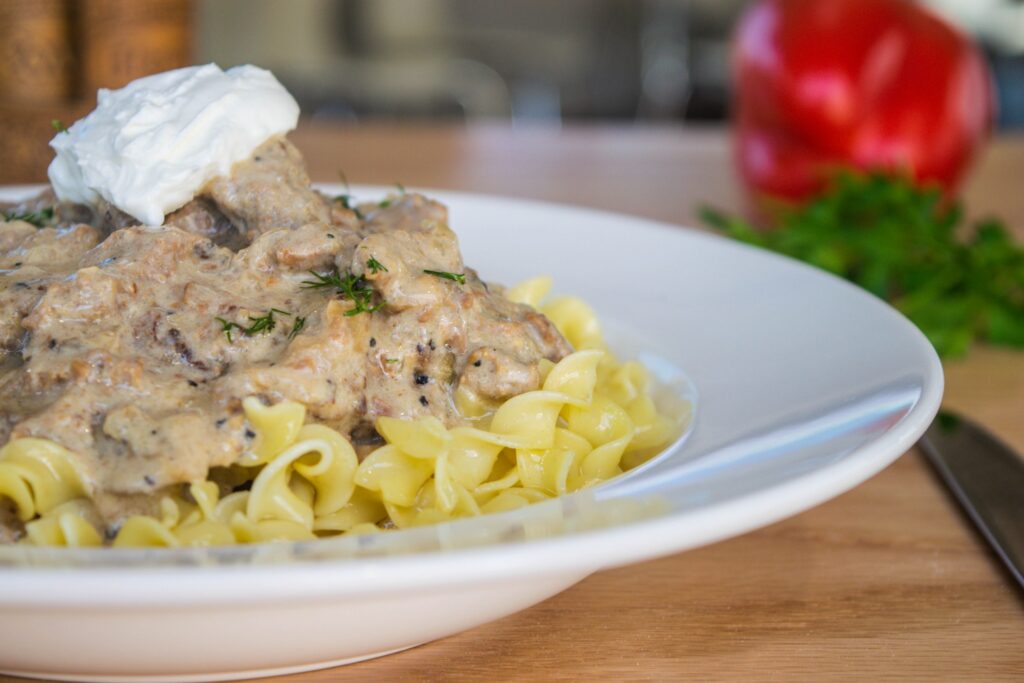
At its core, beef stroganoff is tender strips of beef, sautéed and finished in a rich, creamy sauce made with sour cream and mustard. It’s served over egg noodles, buckwheat, or rice. The sauce should be silky, slightly tangy, and built from real ingredients cooked together in the pan. Not poured in from a can.
The texture of the beef matters. The quality of the sour cream matters. The way the sauce is built, the timing, the balance of acid and richness, all of it matters.
When those things are done right, stroganoff is genuinely one of the more satisfying dishes in the Russian canon. When they’re not, you get the cafeteria version, which is most of what exists in America.
Where It Came From
The dish is named after the Stroganov family, one of the wealthiest noble houses in Imperial Russia. The Stroganovs were merchants, landowners, and patrons of the arts who had a significant influence on Russian culture for several centuries.
The first recorded recipe appeared in a Russian cookbook published in 1871. The dish likely emerged from the intersection of French culinary technique and Russian pantry staples, a combination that defined a lot of aristocratic Russian cooking in the 19th century.
That French influence is worth understanding, because it explains why the dish works.
French cuisine in the 1800s was built on technique: how you sear meat, how you build a sauce, how you layer fat and acid to create depth. Russian cooking had its own strengths, including ingredients like smetana (sour cream), which brought a richness and tanginess that cream alone couldn’t achieve.
The stroganoff recipe brought both traditions together. French method, Russian flavor. The result was something that belonged to neither tradition entirely and both at once.
How It Spread
From the tables of Russian nobility, stroganoff made its way into hotel restaurants and cookbooks across Europe in the late 1800s and early 1900s. It was the kind of dish that traveled well through diplomatic and culinary circles, simple enough to reproduce, impressive enough to serve.
The Soviet era democratized it. What had been an aristocratic recipe became a staple of home kitchens and state canteens across Russia and Central Asia. The ingredients were accessible. The technique was learnable. Generations of home cooks made it their own.
After World War II, Russian and Eastern European immigrants brought it to the United States, where it hit American restaurant menus and home cookbooks in the 1950s and 60s. That’s where things went sideways.
American adaptations replaced smetana with condensed cream of mushroom soup. The beef got cheaper. The technique got skipped. By the time stroganoff became a fixture in school cafeterias and frozen food aisles, it had lost most of what made it interesting in the first place.
The dish got famous. The recipe got lost.
“I Can Make This at Home”
You can. But it’s worth knowing what’s actually involved before assuming the version you’ve had before is the benchmark.
A properly made beef stroganoff starts with the right cut of beef, sliced thin and seared quickly over high heat so it stays tender. The sauce is built in the same pan, using the fond left behind from the sear, finished with real sour cream added at the right moment so it incorporates smoothly without breaking.
The timing matters. Add the sour cream too early or at too high a temperature and it curdles. The mustard needs to be measured. The balance of fat and acid has to be right. Done well, the sauce coats the noodles and the beef in something that feels rich without being heavy.
It’s not an impossible dish. It’s just one where shortcuts are visible in every bite.
Elena’s Version
At Alyonka, beef stroganoff is made the way it was designed to be made: from scratch, with real sour cream, a buttery sauce built in the pan, and your choice of egg noodles, buckwheat, or rice.
Elena has been cooking this food her whole life. The stroganoff on her menu isn’t an interpretation of the dish or a nod to it. It’s the real thing, made by someone who grew up eating it and knows exactly what it’s supposed to taste like.
If you’ve only had the cafeteria version, the difference is significant enough that it’s worth experiencing at least once. Most people who try it at Alyonka stop thinking of stroganoff as a comfort food they already know and start thinking of it as something they want to come back for.
Make a reservation at Alyonka and order it over buckwheat if you want to eat it the way it was meant to be eaten. Alyonka is at 2870 W State St in Boise. Call 208-344-8996 to book your table.
The version you grew up with doesn’t count.